

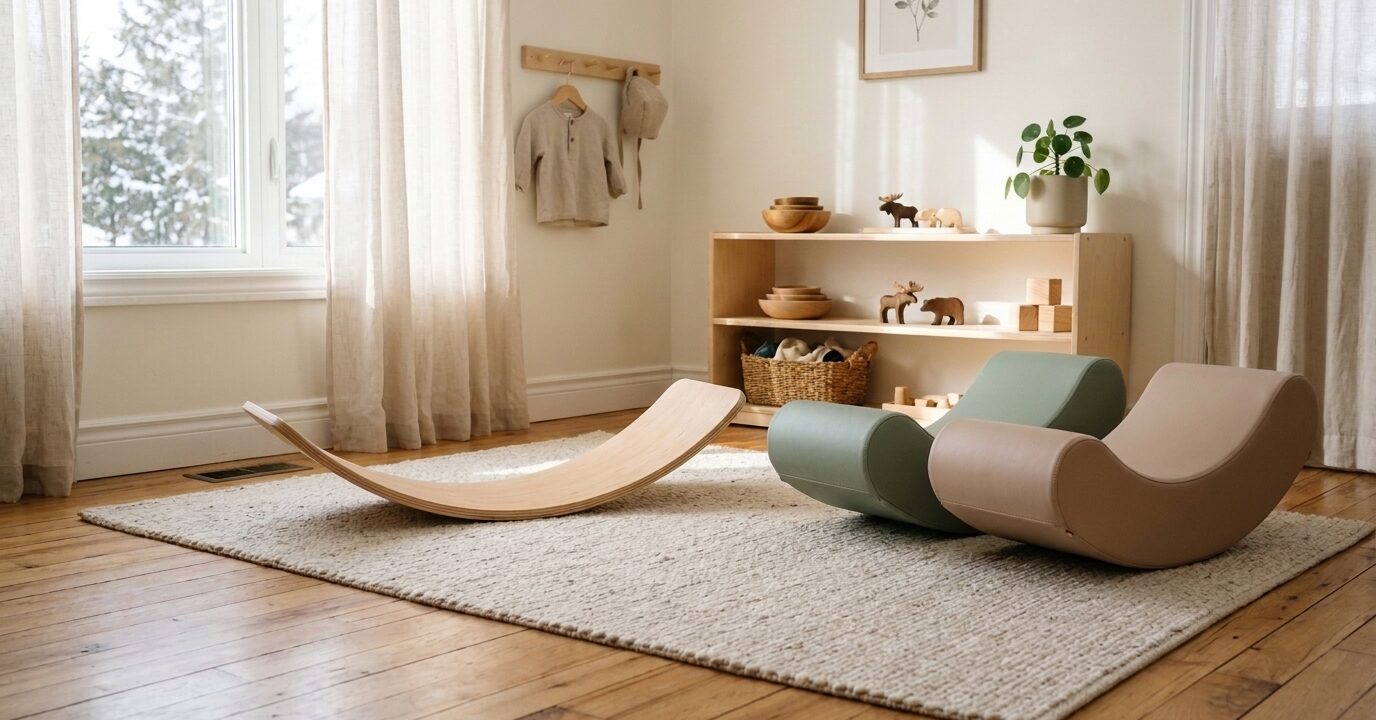

Direct Answer: Soft play foam rockers (like the Pitaya Kids Banana Rocker, Moon Rocker, Car Rocker, and Dog Rocker) give toddlers ages 1 to 3 a cushioned, tip-resistant way to practice vestibular rocking, while curved wooden balance boards (like the Wavyboard Balance Board, $85 CAD) challenge standing balance, core stability, and open-ended play for ages 2 to 8 across Canadian homes and daycare centres.
1. Why Vestibular Rocking & Balance Play Matter
Gentle rocking and standing balance engage a child’s vestibular system (inner-ear balance feedback) and proprioception (body awareness in space). In practical home and Early Childhood Education (ECE) settings, a compact rocker or balance board gives high-energy kids a constructive indoor movement outlet during long Canadian winters without requiring a full playroom footprint.
2. Comparing Soft Play Rockers vs. Wooden Balance Boards (CAD, Checked Nov 2026)
| Product | Material & Feel | Ideal Age Band | Best Use Case | Verified Price (CAD) |
|---|---|---|---|---|
| Wavyboard Balance Board | Curved solid/laminated wood | 2 to 8 years | Standing balance, bridge, tunnel, reading lounge | $85 CAD |
| Banana Rocker | High-density foam + wipeable PU | 1 to 4 years | Cushioned seated rocking, sensory corners | $190 CAD |
| Pitaya Kids Moon Rocker | High-density foam + wipeable PU | 1 to 4 years | Crescent rocking and quiet reading nook | $180 CAD |
| Soft Play Car Rocker | High-density foam + wipeable PU | 1.5 to 4 years | Imaginative roleplay + gentle rocking | $180 CAD |
| Soft Play Dog Rocker | High-density foam + wipeable PU | 1.5 to 4 years | Play cafés, toddler zones, soft play rentals | $190 CAD |
3. Honest Trade-Offs: Which One Should You Buy First?
- Choose a Soft Play Rocker first if your child is 12 to 30 months old or if you run a commercial toddler room where hard wooden edges could bump seated infants. Honest drawback: soft foam rockers take up slightly more storage volume than a flat curved board and are outgrown earlier (around age 4 to 5).
- Choose the Wavyboard Balance Board ($85 CAD) first if you want one multi-year piece for ages 2 to 8 that slides under a sofa when not in use. Honest drawback: bare hardwood floors can be slippery under wooden boards, so always place a low-pile rug or EVA foam play mat underneath and remind kids to keep fingers off the outer bottom rim while rocking.
4. Five Open-Ended Ways Kids Use Balance Boards & Rockers
- Standing wobble challenge: Shift weight left and right while counting aloud or tossing a soft bean bag.
- Flipped arch bridge: Turn a wooden balance board or crescent rocker upside down as a mini climbing hill or car ramp.
- Cozy reading cradle: Add a cushion inside the Banana or Moon Rocker for quiet story time.
- Sensory obstacle course: Pair rockers with a Rainbow Soft Play Climber ($850 CAD) and crawl tunnel for rainy-day gross motor circuits.
- Calm-down corner: Slow rhythmic rocking helps overstimulated toddlers wind down between daycare transitions.
Shop wipe-clean PU foam rockers and curved wooden balance boards shipped across Canada in CAD.
Disclaimer: The information provided in this article is for general educational and informational purposes only and does not constitute medical, pediatric, or legal advice. Consult a qualified professional for specific developmental guidance. Product dimensions and specifications are based on current catalog data and subject to standard manufacturing tolerances.