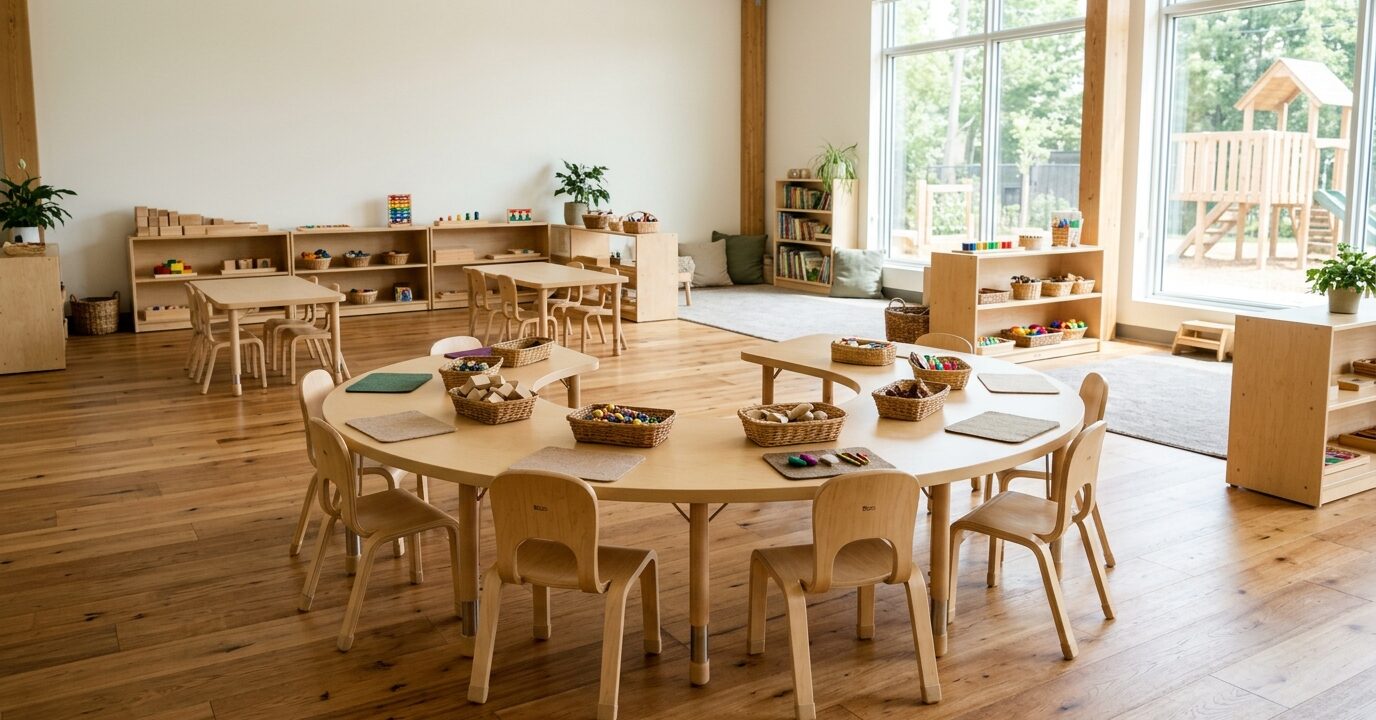

Direct Answer: Choose a U-Shaped (Horseshoe) Classroom Table such as the Pitaya Kids U-Table (160 x 120 x 55 cm, $460 CAD, Checked on November 2026) when one educator needs direct arm’s-reach supervision of 5 to 6 children during speech therapy, phonics, or fine-motor instruction. Choose Rectangular Wooden Tables ($230 to $310 CAD) for modular Montessori work zones that push together or sit flush against walls, and Hexagon Tables ($350 to $680 CAD) for collaborative 6-child art centres.
How Table Geometry Changes Classroom Floor Space and Teacher Reach
In Ontario licensed childcare centres, provincial regulations require at least 2.8 m² (30 sq ft) of unobstructed indoor play floor space per child. Table shape directly determines how many square metres remain for circulation paths and emergency egress.
Most furniture listings only publish the tabletop length and width. However, a classroom table actually consumes its tabletop dimensions plus a 55 cm (21.6 in) chair pull-out and walking clearance zone on every side where a child sits. Below is our floor footprint and teacher reach calculation across all four primary classroom table shapes sold by Pitaya Kids (all prices in CAD, Checked on November 2026):
| Table Shape & Pitaya Kids Model | Tabletop Size (cm & inches) | Total Floor Footprint With Chairs Pulled Out | Child Capacity | Max Teacher Reach Distance to Furthest Child | CAD Price (Checked on Nov 2026) |
|---|---|---|---|---|---|
| U-Shaped (Horseshoe) Table Pitaya Kids U-Table |
160 cm (W) x 120 cm (D) x 55 cm (H) (63.0″ x 47.2″ x 21.7″) |
270 cm x 230 cm 6.21 m² (66.8 sq ft) |
5 to 7 children + 1 educator in centre cutout | 55 to 65 cm (22″ to 26″) Educator can guide every child’s hand without standing up |
$460 CAD |
| Rectangular Classroom Table Wooden Kindergarten Table / MDF Table |
120 cm (W) x 60 cm (D) x 53 cm (H) (47.2″ x 23.6″ x 20.9″) |
230 cm x 170 cm 3.91 m² (42.1 sq ft) |
4 to 6 children | 95 to 115 cm (37″ to 45″) Educator must lean across table or walk around |
$230 to $310 CAD |
| Hexagon Group Table Hexagon Wooden Table |
120 cm diameter x 53 cm (H) (47.2″ dia x 20.9″ H) |
230 cm x 230 cm 5.29 m² (56.9 sq ft) |
6 children (1 per facet) | 120 cm (47.2″) Equal peer eye contact; all supplies shared in centre |
$350 to $680 CAD |
| Height-Adjustable Activity Desk Set Adjustable Kids Activity Table & 4 Chairs Set |
120 cm (W) x 60 cm (D) x 48.2–57.2 cm (H) (47.2″ x 23.6″ x 19.0″–22.5″) |
230 cm x 170 cm 3.91 m² (42.1 sq ft) |
4 children (includes 4 chairs) | 95 cm (37.4″) | $390 CAD (set with 4 chairs) |
Detailed Comparison and Honest Drawbacks for Each Shape
1. U-Shaped (Horseshoe) Teacher Table ($460 CAD)
Built from 18 mm birch plywood with solid wooden legs, the 160 cm x 120 cm x 55 cm U-Table places the educator inside the central cutout while up to six children sit around the outer curve.
- Best Use Case: Reading readiness groups, ESL/French immersion phonics, Montessori three-period lessons, occupational therapy, and assisted toddler feeding where the teacher needs immediate reach to every child’s tray.
- Honest Drawback (Including Our U-Table): A U-table cannot be pushed flush against a flat wall without blocking three seating positions, and its 6.21 m² active footprint is too large for micro-classrooms under 20 m² (215 sq ft). Because the central cutout reduces surface depth to 40–45 cm per child, it also holds fewer oversized 60 cm art posters than a deep rectangular table.
2. Rectangular Wooden & Adjustable Tables ($230 to $390 CAD)
- Best Use Case: Versatile Montessori work cycles and snack rooms. Two rectangular tables can be pushed side-by-side to form a 120 cm x 120 cm square project island for 8 children, or pushed against a wall to serve as a nature science display table.
- Honest Drawback: Children seated at the far corners sit 110+ cm away from the educator, making one-on-one hand-over-hand writing guidance harder without walking around the perimeter.
3. Hexagon Classroom Tables ($350 to $680 CAD)
- Best Use Case: Collaborative art, Lego/building block challenges, and sensory play where six children share a central caddy of markers, scissors, or manipulatives at equal distance.
- Honest Drawback: Angled 60-degree corners cannot sit flush against straight walls or rectangular shelves, leaving unused triangular dead space if placed in a room corner.
Recommended Table Ratio for a 16-to-24 Child Canadian Classroom
Rather than filling a room with a single table shape, the most efficient preschool floor plan combines:
- 1 U-Shaped Table ($460 CAD) in the quiet teacher-led literacy corner, paired with 6 chairs matching our Kids’ Chair & Table Height Chart (28 to 30 cm seat height for ages 3 to 5).
- 3 to 4 Rectangular Tables in the central independent work and meal zone so staff can reconfigure the floor layout in under two minutes.