


“Get down from there!” “Be careful!” “That’s too high!”
If you’re a parent, these phrases are probably second nature. We live in a world obsessed with safety, where every sharp corner is padded and every playground is designed to eliminate all possibility of a bump or scrape. But in our quest to protect our children from every conceivable harm, are we accidentally stripping them of the very experiences they need for healthy child development?
This is the case for risky play. It’s the thrilling, exciting, and sometimes scary-looking play that kids are naturally drawn to—and it’s absolutely essential for raising confident, capable, and resilient human beings.
What Exactly Is “Risky Play”?
Let’s be clear: risky play is not the same as hazardous play. We aren’t talking about letting toddlers play near busy roads or with dangerous tools.
Risky play, often called adventurous play, is about children intentionally seeking out activities that involve a level of challenge, uncertainty, and a perceived risk of physical injury. It’s that feeling of “Oh, this is a little scary… but I think I can do it.”
Common types of risky play include:
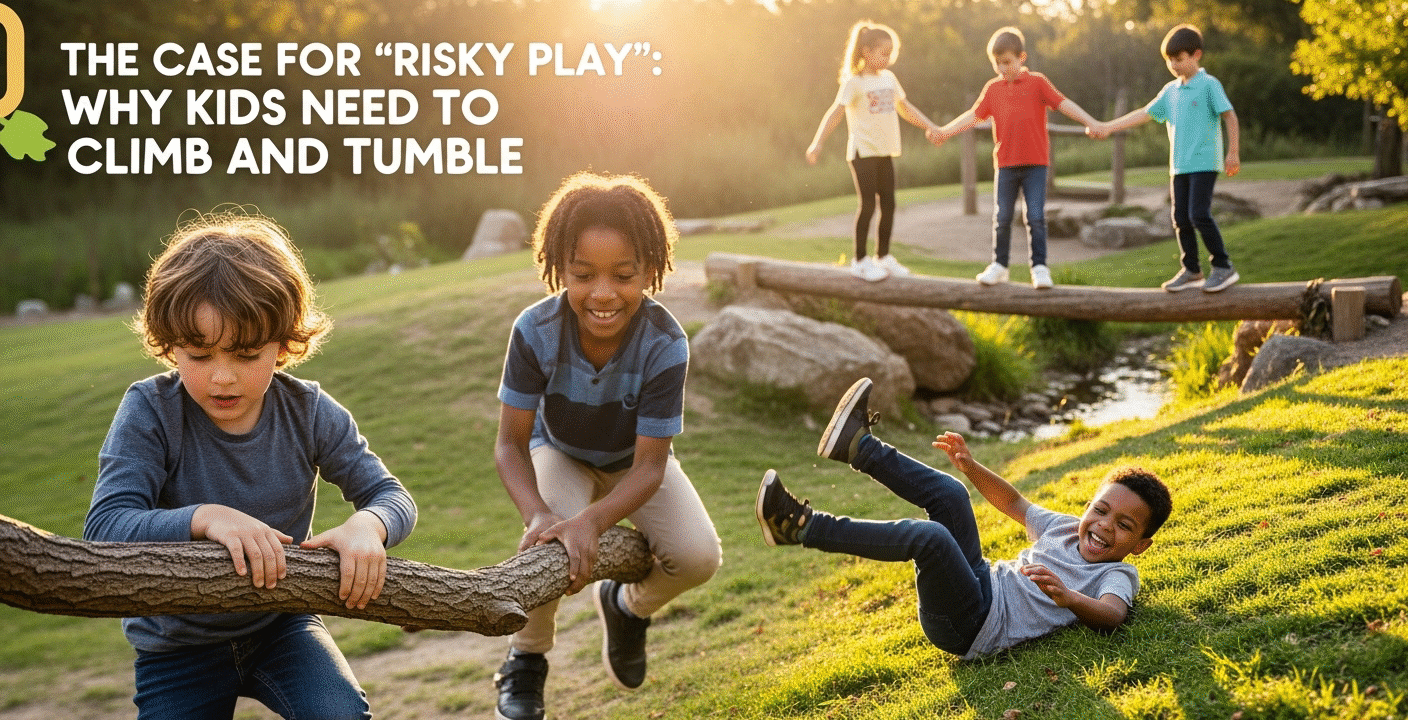
- Playing at Height: Climbing trees, scrambling up playground structures, or balancing on a high log.
- Playing at Speed: Riding a bike fast down a hill, swinging high, or rolling down a grassy slope.
- Rough-and-Tumble Play: Wrestling, play-fighting, and tumbling with friends.
- Playing with “Dangerous” Tools: Supervised use of real tools like a small hammer, saw, or pocket knife.
- Playing Near Elements: Engaging with water, fire (like a supervised campfire), or steep slopes.
- Getting “Lost”: Exploring a wooded area, a new park, or a neighborhood without direct adult supervision.
This kind of unstructured play is driven by the child, not the adult.
🚀 The Surprising Benefits of Risky Play
When we bubble-wrap our children, we’re not just preventing scrapes; we’re preventing learning. The benefits of risky play are profound and impact a child’s entire development.
1. Building Resilience and Emotional Regulation
The number one benefit is building resilience. When a child climbs a little higher than they’re comfortable with, they experience fear. When they manage that fear and succeed (or even slip and recover), they learn a powerful lesson: “I was scared, but I handled it.” This builds confidence and emotional grit far more effectively than any pep talk from a parent.
2. Developing Critical Risk Assessment Skills
This is perhaps the most crucial life skill. How can a child learn to make good judgments if they’ve never been allowed to make any judgments?
Risky play is the primary way children develop their own risk assessment for kids. They learn to scan their environment, listen to their “gut feeling,” and understand their own physical limits. A child who has fallen from a low branch is far less likely to attempt a leap from a high one. We are their external “risk assessors” for too long; they need to develop their own internal one.
3. Enhancing Physical Health and Motor Skills
Climbing, balancing, jumping, and tumbling are fundamental to child development. This kind of vigorous outdoor play builds:
- Muscle strength
- Cardiovascular health
- Balance and coordination
- Spatial awareness
This is the physical literacy they will carry into adulthood.
4. Boosting Problem-Solving and Creativity
Unstructured play is the engine of creativity. When a child is trying to figure out how to build a fort with heavy branches or navigate a tricky climbing route, they aren’t following instructions. They are problem-solving in real-time, adapting to failures, and thinking creatively.
How to Encourage Risky Play (Without Losing Your Mind)
Okay, so the benefits of risky play are clear. But how do you, the justifiably nervous parent, actually allow it?
It’s about shifting your mindset from risk prevention to hazard management.
- A Hazard is something the child cannot see or judge (like a rusty nail sticking out of a board or a rotted tree branch). Your job is to remove hazards.
- A Risk is a challenge the child can see, assess, and choose to take (like a high slide or a wobbly rock). Your job is to let them assess it.
Here are a few practical tips:
- Use the “17-Second Rule”: When you feel the urge to shout “Be careful!”, count to 17. This often gives the child enough time to either solve the problem themselves or realize they need help.
- Ask Questions, Don’t Give Commands: Instead of “Don’t climb that,” try “That looks high. What’s your plan for getting down?” This prompts them to engage their own risk assessment for kids.
- Choose the Right Environment: Seek out natural spaces. Outdoor play in a forest, by a creek, or even in a park with “messy” areas provides infinitely more opportunities for adventurous play than a sterile, rubber-matted playground.
- Step Back (Literally): The closer you hover, the less independent your child will be. Take a few steps back. Give them the space to own their accomplishments and their minor failures.
The Real Risk is No Risk at All
In our effort to create a perfectly safe childhood, we may be creating a generation of young adults who are more anxious, less resilient, and ill-equipped to manage the very real challenges of life.
By re-introducing risky play, we are giving our children a gift. We are teaching them that they are capable, strong, and trustworthy. So take a deep breath, bite your tongue, and let them climb. A scraped knee heals, but the confidence they gain from mastering a challenge will last a lifetime.
Disclaimer: This article is for informational purposes only. The activities described as “risky play” inherently carry risks. Parents and guardians are solely responsible for supervising their children and assessing the safety of any environment or activity. Always prioritize your child’s safety and well-being and use your best judgment.