

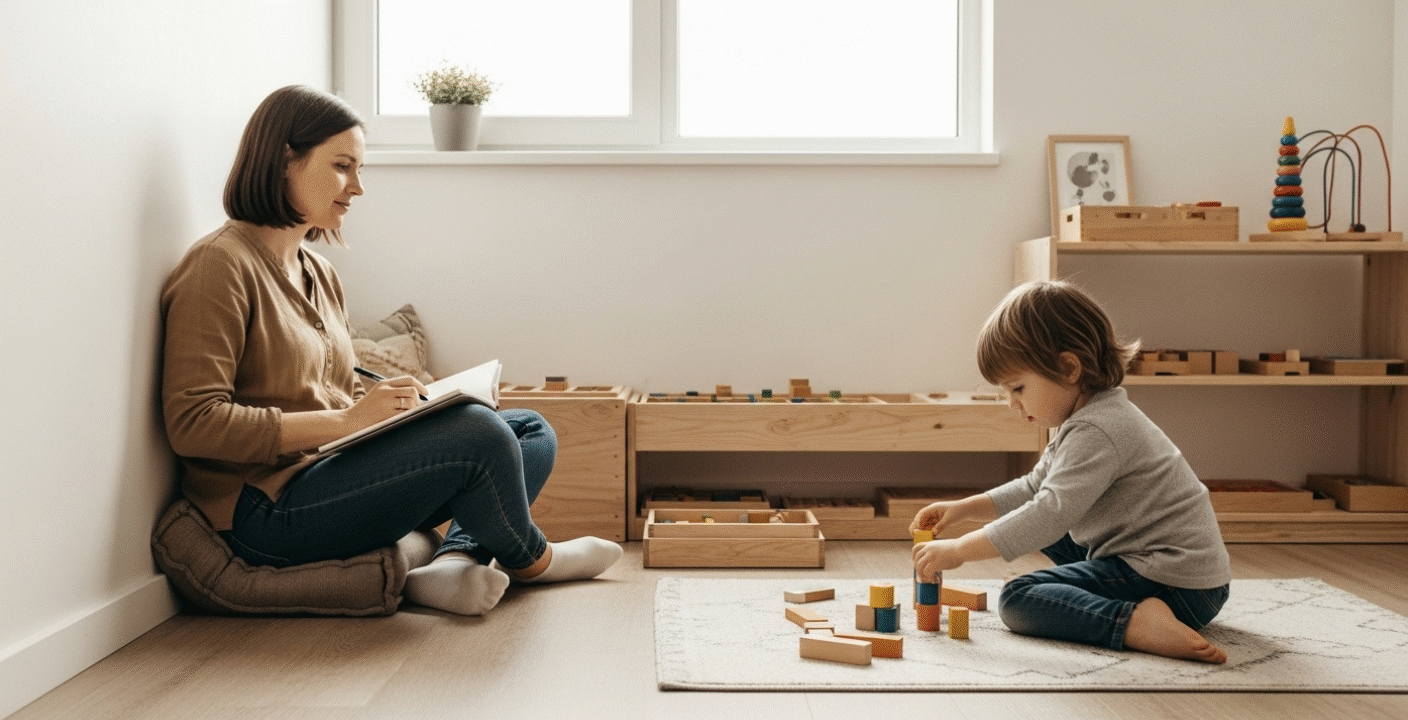

In the world of the Montessori method, there is a tool more powerful than any material or lesson: mindful, scientific observation. As a parent who has embraced this philosophy, I’ve found that the role of observation in Montessori is the most profound way to connect with and truly understand my child. It’s not about watching passively; it’s about seeing your child for who they are and who they are becoming. This guide is designed for parents who want to move beyond reacting and start responding with intention, fostering a deeper bond and supporting their child’s natural development.
This post aims to be a comprehensive resource, moving beyond simple definitions to share actionable insights and the “why” behind this foundational practice. We will explore how to use observation to create a supportive environment for
child-led learning and practice respectful parenting, which are at the heart of the Montessori philosophy.
What is Scientific Observation in a Montessori Context?
Dr. Maria Montessori was, first and foremost, a scientist. She used objective observation to understand children’s true needs and developmental paths. For parents, this means setting aside our own assumptions, judgments, and expectations to see what is actually happening.
The goal is to gather information about your child’s interests, challenges, and unique learning style. Are they drawn to puzzles? Do they struggle with fine motor tasks? When do they show the most focus? Answering these questions through observation, rather than guessing, allows you to prepare an environment that perfectly meets their needs, a core principle of Montessori at home.
How to Practice Observation: A Step-by-Step Guide for Parents
Integrating this practice into your busy life can feel daunting, but it starts with small, intentional moments. Think of it as collecting data out of love and curiosity.
- Step 1: Prepare Yourself and the Space Find a comfortable, unobtrusive spot where you can sit without interrupting your child. The goal is to become part of the background. Put your phone away. Have a notebook and pen ready to jot down what you see, not what you think you see.
- Step 2: Watch with an Open Mind Observe without an agenda. Don’t look for mistakes to correct or opportunities to praise. Simply be present. My own “aha” moment came when I stopped trying to guide my son’s block-building and just watched; I noticed he wasn’t just stacking, he was meticulously sorting by color, a detail I had previously missed entirely. This is the kind of insight that observation provides.
- Step 3: Document Objectively Write down only the facts. Instead of writing, “He got frustrated,” write, “He sighed loudly and pushed the blocks away.” Instead of, “She loves her new puzzle,” document, “She worked on the puzzle for 15 minutes without interruption.” This objective record is crucial for identifying patterns over time.
- Step 4: Reflect on Your Notes Later, look over your notes. What do they tell you? You might notice your child consistently chooses activities that involve pouring, signaling a readiness to develop fine motor skills. You might see they are most focused in the morning, which helps you schedule challenging activities. This is how you use observation to become a “guide” for your child’s learning journey.
Turning Observation into Action: Supporting Your Child’s Development
The true power of the role of observation in Montessori comes when you use your insights to make meaningful changes. This demonstrates to your child that you see them and respect their inner drive.
- If you observe intense focus on a specific skill: Provide more materials that support that interest. If they love sorting, introduce containers and different objects to sort by size, shape, or texture.
- If you observe a struggle or frustration: Don’t jump in to solve it. Instead, think about how you can simplify the task or model the skill at a later time. This fosters resilience and child development.
- If you observe a need for movement: Ensure your daily routine includes plenty of opportunities for gross motor activity, like running outside or having a dance party.
By tailoring the environment and your interactions to what you observe, you are not just applying a technique; you are practicing deep, respectful parenting. You are communicating to your child: “I see you. I trust your process. I am here to support you.” This trust is the foundation of the Montessori approach and is essential for helping your child build a lifelong love of learning.
Disclaimer: This blog post is for informational purposes only and is based on personal experience and understanding of the Montessori philosophy. It does not constitute professional educational or developmental advice. Please consult with a qualified Montessori educator or child development specialist for guidance tailored to your child’s specific needs.